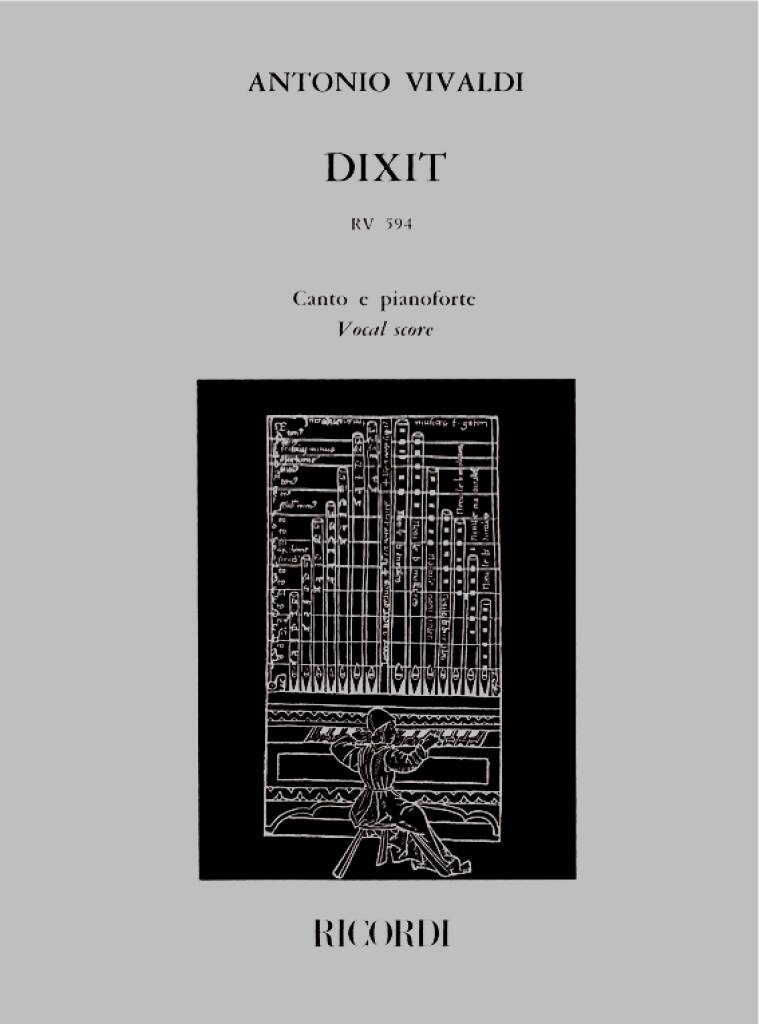
Vivaldi: Dixit RV 594, Psalm 109 (Vocal Score)
NR13146700
På lager
229,00 kr.
Fri fragt over 599,- (Pakkeshop i DK)
Læs mere- Foreword in two languages (Eng/Ger)
- Detailed Critical Commentary (Eng)
- Practical, manageable piano reduction
Editor: Malcolm Bruno & Caroline Ritchie
Arranger: Klaus Winkler
About the arrangement:
It is hard to imagine today that the music of J. S. Bach fell into oblivion for about half a century after the composer’s death. His successors at the Thomaskirche preferred simpler homophonic compositions, and by the beginning of the 19th century his music served only as a subject of academic study. The composer and teacher Carl Friedrich Zelter greatly appreciated Bach’s contrapuntal artistry and passed it on to his pupil Felix Mendelssohn who, by the age of twelve, had become a master of the art of the fugue. Two years later, the young Felix was to receive his most valuable gift, a hand-copied score of Bach’s St. Matthew Passion. With Zelter at his side, he gave the first performance (since Bach’s death) in 1829 with musicians from the Berlin Singakademie.
It was an ambitious undertaking, not only because of the complexity of Bach’s music, but also because of the unfamiliarity by that time with Baroque performance practice (size of instrumentation, Baroque instruments, ornamentation, etc.).
Twelve years passed before Mendelssohn made another attempt to perform the “Great Passion Music” as he called it – this time as part of a Bach series in Leipzig’s Thomaskirche. For this performance, he reinstated a number of arias that he had deleted in 1829 and revised the secco recitatives so that no keyboard instrument was required. This 1841 version still followed a shorter conception of the work and comprised about two-thirds of the original, roughly the same size as the St. John Passion. What Mendelssohn left behind when he died a few years later must be seen as a “version in progress” on which he had certainly intended to continue working.
The new Bärenreiter edition returns to Mendelssohn’s unique vision of Bach’s masterpiece. By bringing together what Mendelssohn had sketched and including supplements to certain parts by the editor, the work is now presented in its reduced form, with the revised part for the Evangelist (in the secco recitatives with orchestral accompaniment), with clarinets replacing the oboe d’amore, and with a suggestion for the missing continuo part (which had been begun for the Thomaskirche organ but remained unfinished or was lost). The new edition shows not only Mendelssohn’s imaginative reinterpretation of the original, but also the versatility of Bach’s music in his hands. In an age in which Bach is played almost exclusively by Baroque ensembles, it allows them the opportunity to perform one of Bach’s greatest works from a 19th century perspective.

Vi lytter til dine behov og hjælper dig med at finde et setup, der passer til både ambitioner og budget.

Sortimentet er kurateret med fokus på spilleglæde, kvalitet og værdi for pengene.

Dit udstyr pakkes omhyggeligt og sendes hurtigt, så du kan komme videre med musikken.

Vi er også klar, når du har spørgsmål til opsætning, tilbehør eller dit næste skridt.
inkl. moms ekskl. fragt
Få på lager
Få på lager
inkl. moms ekskl. fragt
Få på lager
Få på lager