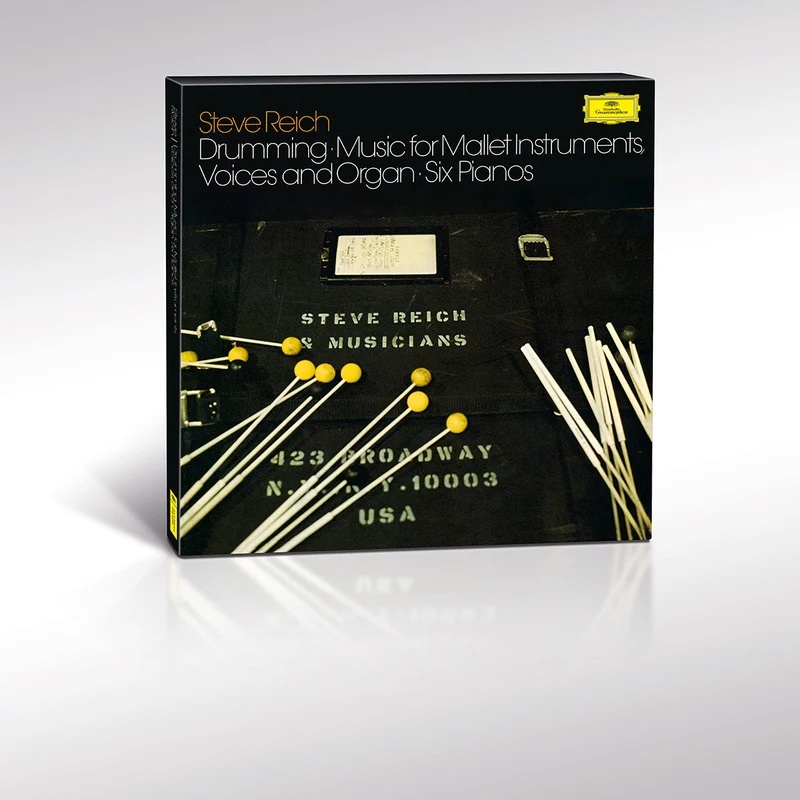
Steve Reich: Drumming; Music For Mallet Instruments, Voices and Organ; Six Pianos (3LP, The Original Source, Ltd, Num)
028948682232
699,00 kr.
Fri fragt over 599,- (Pakkeshop i DK)
Læs mereinkl. moms ekskl. fragt
Midlertidigt udsolgt
Midlertidigt udsolgt
The Violin Concerto in D minor (1822) was composed when Mendelssohn was only thirteen, and is dedicated to his friend and violin instructor, Eduard Rietz. In three movements (fast–slow–fast), it is scored for string orchestra, and betrays two diverse influences. First is the French violin school of Viotti and his Parisian followers, among them Pierre Rode, Pierre Baillot (with whom the young Mendelssohn had studied in Paris in 1816), and Rodolphe Kreutzer. And second is the influence of C P E Bach and the North German school of string symphonists. The three movements suggest a clear historical progression, beginning with the first that, with its angular, interrupted melodic lines, recalls the mannered empfindsam (ultra-sensitive) style of C P E Bach. Quite in contrast is the opening of the slow movement, based on a theme at once serenely classical, and Mozartian in its poise. The finale, a brisk rondo in a popular style, bristles with solo figurations that reflect the virtuoso styles of Mendelssohn’s own time.
Some twenty years later, the composer returned to the genre to produce one of his most admired works, the Violin Concerto in E minor, Op 64, for his friend Ferdinand David, concertmaster of the Leipzig Gewandhaus Orchestra. Its formal perfection and exquisite craft conceal the remarkably slow gestation of the concerto, which required a full seven years, from 1838, when Mendelssohn began to ruminate about the elegiac opening theme that ‘gave him no peace’, to 1845, when David finally premiered the work in Leipzig shortly before its publication. Along the way, Mendelssohn set aside the project to contemplate writing a piano concerto in E minor for London, of which he drafted, sometime between 1842 and 1844, a first movement and sketched a second. Here we find the origins of the lyrical second theme in the first movement of Op 64. But Mendelssohn gave up the piano concerto to return to his original task. He dated his score of the violin concerto in September 1844, though almost immediately began to incorporate fine retouches. One, more substantial change resulted from his consultations with David: Mendelssohn lengthened the celebrated cadenza in the first movement, which, unusually, appears at the end of the development instead of near the end of the recapitulation, its traditional position.
The placement of the cadenza was one novelty that influenced later composers (notably Sibelius in his violin concerto of 1903). Another was the remarkable opening of Mendelssohn’s concerto, which inverts the traditional tutti–solo arrangement, so that at the outset the soloist introduces the pensive theme, set high above a rustling orchestral accompaniment, that eventually builds and spills over into the delayed orchestral tutti. This device spawned many imitations, and arguably influenced some composers usually not at all associated with Mendelssohn’s refined romanticism (for example Rachmaninov and Bartók, in their third piano concertos).
Like Mendelssohn’s two completed piano concertos, Opp 25 and 40, Op 64 is in three movements connected by two transitions, a design that traces its lineage from Carl Maria von Weber’s Konzertstück for piano and orchestra of 1821, which features four compact, connected movements. The passionate, agitated quality of Mendelssohn’s first movement gives way to a warmly lyrical, Lied-ohne-Worte-like slow movement in C major. Only its contrasting middle section, which turns to A minor, recalls in its quivering tremolos something of the character of the first movement. The brisk E major finale, announced by celebratory wind fanfares, offers a capricious scherzo that unfolds as a rondo on two alternating themes—the first, a fleet-footed, delicate figure in the solo violin, and the second, a march-like subject that impresses perhaps as a nimble cousin of the contemporaneous Wedding March in the Midsummer Night’s Dream incidental music. Mendelssohn’s irrepressible finale harnesses an effervescent virtuosity to a clear, translucent design at once satisfying in its unexpected excursions and formal balance.
Alina Ibragimova (violin), Orchestra of the Age of Enlightenment, Vladimir Jurowski (conductor)
Tracklist:
Side A
Violin Concerto in E minor Op 64 [25'45]
1 Allegro molto appassionato [12'16]
2 Andante [6'59]
3 Allegretto non troppo – Allegro molto vivace [6'30]
Side B
Violin Concerto in D minor [21'34]
1 Allegro [8'38]
2 Andante [8'50]
3 Allegro [4'06]

Vi lytter til dine behov og hjælper dig med at finde et setup, der passer til både ambitioner og budget.

Sortimentet er kurateret med fokus på spilleglæde, kvalitet og værdi for pengene.

Dit udstyr pakkes omhyggeligt og sendes hurtigt, så du kan komme videre med musikken.

Vi er også klar, når du har spørgsmål til opsætning, tilbehør eller dit næste skridt.
inkl. moms ekskl. fragt
Midlertidigt udsolgt
Midlertidigt udsolgt