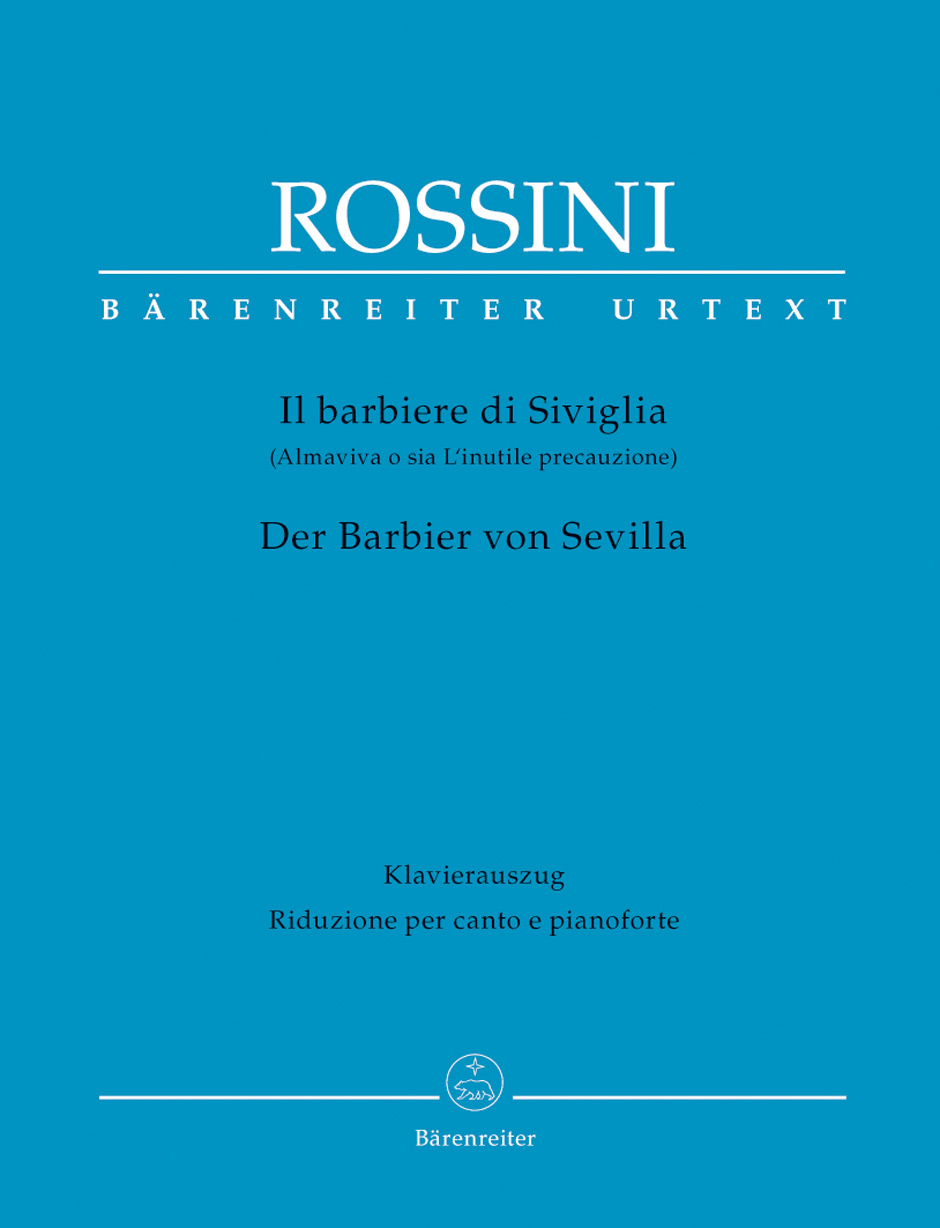
Rossini: Il barbiere di Siviglia (The Barber of Seville) - Vocal Score
BA10506a
På lager
Fra439,00 kr.
Fri fragt over 599,- (Pakkeshop i DK)
Læs mereOper - Klavierauszug nach dem Text der Richard-Wagner-Gesamtausgabe herausgegeben von Egon Voss WWV 96 - Klavierauszug Herausgeber: Voss, Egon An important addition to our newly produced orchestral materials is the first publication of vocal scores of Wagner’s ten great operas, in every important version, based on the Complete Edition. * The score corresponds to the performance materials from the Complete Edition. * For practical use in rehearsal cues and bar numbers throughout. * The publisher has secured the services of renewed musicologists associated with the Richard Wagner Complete Edition who convey detailed information in critical forewords. * The forewords are given in three languages(German, English, French). * Uniform and attractive front cover designs with reproductions of paintings from the Wagner era underline the series design of the edition. DIE MEISTERSINGER VON NÜRNBERG “Die Meistersinger von Nürnberg is today still considered a German festival and national opera: this evaluation is borne out by the opera’s performance history, the history of its reception and customary performance practice. Critical minds will perhaps recall the quotation from Friedrich Nietzsche’s publication "Jenseits von Gut und Böse" [Beyond Good and Evil] in which the Vorspiel [Prelude] to Meistersinger is described as ‘magnificent, ornate and ponderous art’ and Wagner’s music in general as being ‘rough and coarse’. This music according to Nietzsche possesses ‘no trace of the fine southern clarity of the sky and nothing of grace’, but instead ‘a cumbersome garb, with a touch of licentious barbarism and solemnity’ and ‘even a certain degree of ungainliness’. Nietzsche’s evaluation is regarded by many as an insight into the essence of the matter, although it is evident that Nietzsche was exaggerating in order to be provocative. What is more important today is however that this characterisation appears to have been the result of an approach to the performance of Meistersinger which had neglected or even gone as far as to misappropriate elements of this work. This is also the conclusion reached in the Meistersinger Edition of the Critical Complete Edition of the Musical Works of Richard Wagner (Richard Wagner, Sämtliche Werke, Vol. 9, I-III, edited by Egon Voss, Mainz 1979-1987). It has in fact been established that the first print of the score published by B. Schott’s Söhne in Mainz in 1868 contained numerous errors and omissions, particularly with regard to dynamic markings and articulation. The difference between staccato dots and dashes which has an influence on the tone was simply ignored. The substantial omission of these staccato markings unambiguously draws attention to the fact that Wagner intended a lighter-weight sound than was produced in adherence the first edition. The same also holds true for the dynamic markings which were submitted to a general levelling process in the first edition, thereby entirely masking their original broad scope of differentiation. […] When the saying ‘the music sets the tone’ is cited, it is in actual fact tempo, dynamics which are implied. If the new findings incorporated into the Meistersinger edition of the Critical Complete Edition are taken seriously, this will inevitably produce a new Meistersinger sound.” (Egon Voss, quoted from the foreword of the new Meistersinger vocal score; translated by Lindsay Chalmers-Gerbracht) Inhalt/

Vi lytter til dine behov og hjælper dig med at finde et setup, der passer til både ambitioner og budget.

Sortimentet er kurateret med fokus på spilleglæde, kvalitet og værdi for pengene.

Dit udstyr pakkes omhyggeligt og sendes hurtigt, så du kan komme videre med musikken.

Vi er også klar, når du har spørgsmål til opsætning, tilbehør eller dit næste skridt.
inkl. moms ekskl. fragt
Få på lager
Få på lager